Pictured left is Michaelangelo's The Torment of St. Anthony (1487-9). It depicts the saint's trials against demonic forces in the wilderness.
O our venerable and God-bearing Father Anthony! We believe that you have great boldness in prayer standing before the throne of the Holy Trinity, and the All-Merciful Lord always hears you, His faithful servant. Wherefore, we humbly fall down before you with compunction, Saint of God: never cease to intercede for us to the Lord, Who is worshiped and glorified in the Trinity, that He may look mercifully on us and not let us perish in our sins, but would raise the fallen and give correction to the evil and wretched lives, averting our future transgressions, and forgive all faults committed in word or thought from our birth to the present hour. O ascetic of virtue, seeing the infirmity and sorrow of the present times, do not cease to entreat Christ God to not withdraw from us His loving-kindness, but to preserve us from worldly temptations, devil’s snares, and fleshly desires, so that we may receive all necessary for this temporary life, deliverance from affliction and tribulation, and unyielding patience to the end. Implore that we may lead the rest of our lives in peace and repentance and to pass from earth to heaven escaping tribulations, demons of the air, and eternal torments, and be worthy of the Heavenly Kingdom with you and all the saints that pleased our Lord God and Savior Jesus Christ, to Whom is due all glory, honor, and worship, together with His Father without beginning and His All-Holy, Good and Life-Creating Spirit, now and ever and unto ages of ages. Amen.
- CONVERSION TO ORTHODOXY
- VESTMENTS
- LUTHERANISM
- Response to "A Lutheran Looks at ... Eastern Orthodoxy"
- Proper Distinction of Man
- Theology of What?!
- Theologians of the Cross, Glory, and Orthodoxy
- The Fathers and Romans 7:14-25
- Vicarious - yes; Satisfaction - huh?
- Wrath and Justification
- The Wrath of God (continued)
- Responding to Fr. Burnell Eckardt's "Temptations"
- Sacrifice Without Punishment
- Pay No Attention to the Man Behind the Curtain
- Be Reconciled
- The Eucharist Is Essential
- Introducing a New Thing
- Response to Quiet George
- The Wedge Becomes the Ax
For I received from the Lord that which I also delivered to you... 1 Cor. 11:23
Showing posts with label Liturgical Calendar. Show all posts
Friday, January 17, 2014
Preserve Us Against the Evils in the World
Friday, June 25, 2010
Nativity of St. John the Baptist (yesterday)
O Prophet and Forerunner of the coming of Christ, we honour thee lovingly but cannot extol thee worthily; for by thy birth thy mother's barrenness and thy father 's dumbness were unloosed; and the Incarnation of the Son of God is proclaimed to the world.
--Troparion, Tone 4
O God, let Your Church rejoice over the birth of blessed John the Baptist, for through him she came to know the author of her own birth, Jesus Christ, Your Son our Lord; who lives and rules with You .
--Postcommunion (Western Rite)
My family enjoyed Mass at Holy Incarnation Antiochian Orthodox Church yesterday in celebration of the nativity of St. John the Baptist. We lost track of what day it was, so it was by chance we were available to attend. What a blessing!
Visit the Antiochian Archdiocese Web site for resources related to this Great Feast of the Church.
--Troparion, Tone 4
O God, let Your Church rejoice over the birth of blessed John the Baptist, for through him she came to know the author of her own birth, Jesus Christ, Your Son our Lord; who lives and rules with You .
--Postcommunion (Western Rite)
My family enjoyed Mass at Holy Incarnation Antiochian Orthodox Church yesterday in celebration of the nativity of St. John the Baptist. We lost track of what day it was, so it was by chance we were available to attend. What a blessing!
Visit the Antiochian Archdiocese Web site for resources related to this Great Feast of the Church.
Monday, April 5, 2010
Christos ist Auferstanden!
Christ is risen from the dead trampling down death by death and upon those in the tombs bestowing life.
Christ is risen!
Indeed He is risen!
Christos ist auferstanden!
Sicherlich ist auferstanden!
Harisutosu fukkatsu!
Jitsu-ni fukkatsu!
This last one is a version from Japanese, while the one previous is German, and I think we all recognize the English. I have some doubts about the common translation flying around for the Japanese, which is often rendered "Harisutosu," a rendering I cannot find in any Japanese dictionary. (It might be a way of transliterating "Christos" from some other language.) Rather, Christ is normally rendered as "Kirisuto" with "fukkatsu" referring to reviving or restoring.
I got our priest to give the Japanese a try as a Paschal greeting this year. He loved the idea. He also wanted to include the German. He said that about 1/4 Americans have some German ancestry. Also, it seems fitting given the number of formerly Lutheran families in the parish. This Saturday our parish received a family of four (now former) Lutherans by Chrismation. (I only learned that they were from a Lutheran background just the other day.)
We spent the entire week in Fort Wayne so we could attend the liturgical services of Holy Week. We purchased the Archdiocese's liturgical book for The Services of Great and Holy Week and Pascha, edited and arranged by V. Rev. Fr. Joseph Rahal. It seems that much of the work for this book was done by Fr. Joseph when he was priest at our parish some years ago - or so I'm told.
Holy Week was wonderful and we didn't want it to come to an end.
One thing was striking last night, after coming back to Defiance tired and happy from such a wonderful week: When the day was drawing to a close I suddenly looked to my Holy Week liturgical book and felt a hollow feeling in my stomach. I had gotten quite used to being able to open that book and review what tomorrow had in store for me. Now the book has to be written as I go.
Christos Anesti!
Alithos Anesti!
Friday, December 25, 2009
The Nativity of Our Lord
We just returned from the Nativity Liturgy at St. John Chrysostom in Fort Wayne. Thankfully the weather forecasters were a bit off in their predictions. We were supposed to have freezing rain about the time of the Liturgy, but instead God granted us clear and safe roads going and returning.
The Liturgy was beautiful. This is our first Christmas at St. John Chrysostom. Last year we were rather displaced with me being a catastrophic mess and bad weather. We had not found St. John Chrysostom yet. It was sad to be unable to celebrate Christmas at church last year. This year all things are new, though. We are newly Sealed and were able to celebrate Christ's nativity as one should: by worshiping the Son of God who lowered Himself beneath all other people in order to raise all people up to His level (as Fr. Anthony preached today), which takes place ever so wonderfully in the communion of Christ's Holy Body and Precious Blood in the unity of the Holy Spirit. For us it has truly been a celebration of Christ's Mass this year.
However, this Christmas is a little stranger than past Christmases, too. We are the only ones in our family - maybe in all of Defiance - who are Orthodox. Our families are great toward us, but there is sometimes an air of uncomfortableness. It's because we don't fit in the same way we used to fit. I imagine that it seems as if we've chosen something that seems strange and a bit extreme to our Protestant relatives. There are certain passages in the Gospel that stick out for me anew now that I am Orthodox, and if you're Orthodox you might guess which ones they are.
However, I offer myself (and anyone else in my shoes) this encouragement: Orthodoxy alone in the world knows both the joy of God's gift of redemption in Christ AND the warfare of the Christian life AND the ecclesial reality of Christ's kingdom on earth (I'm sure I could throw in a few more ANDs in there, too). My introduction into a more serious Christianity was maybe twelve years ago, and it was like basic training conducted in a battle zone. Now that I'm in Orthodoxy it is apparent that the true nature of the warfare is not only known, but it has been engaged with a consistent vision, a single multifaceted gaze piercing eschatologically through the sands of history, arming the saints in the Holy Spirit, healing the wounded with the Blood of Christ, and carrying on the victory of the Cross by the grace of our God who is glorious in His saints and calls us to share in His own glory.
I am a lazy man and tempted kick back in the face of God's goodness and condescension. May He forgive me and teach me to engage the activity of the life He has given me in Christ.
The Liturgy was beautiful. This is our first Christmas at St. John Chrysostom. Last year we were rather displaced with me being a catastrophic mess and bad weather. We had not found St. John Chrysostom yet. It was sad to be unable to celebrate Christmas at church last year. This year all things are new, though. We are newly Sealed and were able to celebrate Christ's nativity as one should: by worshiping the Son of God who lowered Himself beneath all other people in order to raise all people up to His level (as Fr. Anthony preached today), which takes place ever so wonderfully in the communion of Christ's Holy Body and Precious Blood in the unity of the Holy Spirit. For us it has truly been a celebration of Christ's Mass this year.
However, this Christmas is a little stranger than past Christmases, too. We are the only ones in our family - maybe in all of Defiance - who are Orthodox. Our families are great toward us, but there is sometimes an air of uncomfortableness. It's because we don't fit in the same way we used to fit. I imagine that it seems as if we've chosen something that seems strange and a bit extreme to our Protestant relatives. There are certain passages in the Gospel that stick out for me anew now that I am Orthodox, and if you're Orthodox you might guess which ones they are.
However, I offer myself (and anyone else in my shoes) this encouragement: Orthodoxy alone in the world knows both the joy of God's gift of redemption in Christ AND the warfare of the Christian life AND the ecclesial reality of Christ's kingdom on earth (I'm sure I could throw in a few more ANDs in there, too). My introduction into a more serious Christianity was maybe twelve years ago, and it was like basic training conducted in a battle zone. Now that I'm in Orthodoxy it is apparent that the true nature of the warfare is not only known, but it has been engaged with a consistent vision, a single multifaceted gaze piercing eschatologically through the sands of history, arming the saints in the Holy Spirit, healing the wounded with the Blood of Christ, and carrying on the victory of the Cross by the grace of our God who is glorious in His saints and calls us to share in His own glory.
I am a lazy man and tempted kick back in the face of God's goodness and condescension. May He forgive me and teach me to engage the activity of the life He has given me in Christ.
Glory to God in the highest,
and on earth peace, good will among men.
We praise Thee, we bless Thee,
we worship Thee, we glorify Thee,
we give thanks to Thee for Thy great glory.
O Lord, heavenly King, God the Father Almighty;
O Lord, the Only-Begotten Son, Jesus Christ; and O Holy Spirit.
O Lord God, Lamb of God, Son of the Father,
that takest away the sin of the world, have mercy on us;
Thou that takest away the sins of the world, receive our prayer;
Thou that sittest at the right hand of the Father, have mercy on us.
For Thou only art holy,
Thou only art the Lord, O Jesus Christ, to the glory of God the Father. Amen.
Every day will I bless Thee and I will praise Thy name forever, yea forever and ever.
Vouchsafe, O Lord, to keep us this day without sin.
Blessed art Thou, O Lord, the God of our fathers,
and praised and glorified is Thy name unto the ages. Amen.
Let Thy mercy, O Lord, be upon us according as we have hoped in Thee.
Blessed art Thou, O Lord, teach me Thy statutes.
Lord, Thou hast been our refuge in generation and generation.
I said: O Lord, have mercy on me, heal my soul, for I have sinned against Thee.
O Lord, unto Thee have I fled for refuge, teach me to do Thy will, for Thou art my God;
For in Thee is the fountain of life, in Thy light shall we see light.
O continue Thy mercy unto them that know Thee.
Holy God, Holy Mighty, Holy Immortal, have mercy on us.
Glory to the Father, and to the Son, and to the Holy Spirit, both now and ever, and unto the ages of ages. Amen.
Holy Immortal, have mercy on us.
Holy God, Holy Mighty, Holy Immortal, have mercy on us.
Sunday, December 6, 2009
The Feast of St. Nicholas the Wonderworker, Archbishop of Myra in Lycia

Troparion, Tone 4
The truth of things revealed thee to thy flock as a rule of faith, a model of meekness, and a teacher of temperance. Therefore thou hast won the heights by humility, riches by poverty. Holy Father Nicholas, intercede with Christ our God that our souls may be saved.
Kontakion, Tone 3
Thou wast a faithful minister of God in Myra, O Saint Nicholas. For having fulfilled the Gospel of Christ, thou didst die for the people and save the innocent. Therefore thou wast sanctified as a great initiator of the grace of God.
As a convert from a Protestant religious system to Holy Orthodoxy, the issue of sanctification has stuck out to me as one of the primary differences between where I was and where I am in the Orthodox Church (even as a catechumen). Some may dismiss the life of St. Nicholas (below) as just a bunch of myth. I, for one, cannot know either way. I cannot go back in time to find epistemological certainty or uncertainty. I can only hear what the Church has seen and touched and known from her hundreds of years of experience. And I can see that what is told in the life of St. Nicholas is consistent with the saving work of Christ in the Holy Spirit.
There's the rub: that a man - St. Nicholas or anyone else - could be said to appear in dreams, to calm storms, to fail to decay and to stream miraculously-healing myrrh from his relics is to claim something about the nature of salvation. Those Lutherans that will still speak to me in peace like to suggest that the Orthodox fail to distinguish between justification and sanctification - i.e. that there is a difference between what God does in order to accept you (punishes Christ instead of you in order to sate His wrath against sin - what Lutherans call justice) and what God does in you (abides in you, cleanses you, raises up the new man in you, and all sorts of good things that the Orthodox are familiar with). If God is primarily concerned with getting you to believe a message of forgiveness, then personal responsibility and active participation in a personal relationship with God which itself sanctifies you through obedient faith is an after-effect and not salvation itself.
But in the Church justification and sanctification are not so separated, as they are so artificially and mistakenly by our well-meaning Protestant friends. Both being made righteous (justification) and being made holy (sanctification) are a spiritual healing that Christ has effected upon our nature by Incarnation and Passion. And the Holy Spirit unites us to this work of Christ and applies it on the level of our unique persons: healing and release from death and it's sting (sin) and vivification and glorification. Their application is not merely a status issue, but comes through the personal energies of God communicated in Baptism/Christmation and the Eucharist and all the sacraments of the Church - and from this context faithful/obedient living out of the Church's life personally in ascetic struggle.
Wonderworking in the saints is nothing out of the ordinary, because they live by the life of Christ directly, communicated to them personally. Both the sorrow of the cross and the glory of the resurrection are found in the saints in Orthodoxy. In Christ they are not of this world but of the next, and in them we see - in sometimes startling ways - the Eschatological Age breaking forth already through them, as if they had themselves become sacraments and icons of the kingdom. But what else should we expect from those who so purposely died every day to the world and so hungrily fed on Christ as their only life, with the Father and Holy Spirit ever reigning.
The following is from the Orthodox Church in America Web site:
Saint Nicholas, the Wonderworker, Archbishop of Myra in Lycia is famed as a great saint pleasing unto God. He was born in the city of Patara in the region of Lycia (on the south coast of the Asia Minor peninsula), and was the only son of pious parents Theophanes and Nonna, who had vowed to dedicate him to God.
As the fruit of the prayer of his childless parents, the infant Nicholas from the very day of his birth revealed to people the light of his future glory as a wonderworker. His mother, Nonna, after giving birth was immediately healed from illness. The newborn infant, while still in the baptismal font, stood on his feet three hours, without support from anyone, thereby honoring the Most Holy Trinity. St Nicholas from his infancy began a life of fasting, and on Wednesdays and Fridays he would not accept milk from his mother until after his parents had finished their evening prayers.
From his childhood Nicholas thrived on the study of Divine Scripture; by day he would not leave church, and by night he prayed and read books, making himself a worthy dwelling place for the Holy Spirit. Bishop Nicholas of Patara rejoiced at the spiritual success and deep piety of his nephew. He ordained him a reader, and then elevated Nicholas to the priesthood, making him his assistant and entrusting him to instruct the flock.
In serving the Lord the youth was fervent of spirit, and in his proficiency with questions of faith he was like an Elder, who aroused the wonder and deep respect of believers. Constantly at work and vivacious, in unceasing prayer, the priest Nicholas displayed great kind-heartedness towards the flock, and towards the afflicted who came to him for help, and he distributed all his inheritance to the poor.
There was a certain formerly rich inhabitant of Patara, whom St Nicholas saved from great sin. The man had three grown daughters, and in desparation he planned to sell their bodies so they would have money for food. The saint, learning of the man's poverty and of his wicked intention, secretly visited him one night and threw a sack of gold through the window. With the money the man arranged an honorable marriage for his daughter. St Nicholas also provided gold for the other daughters, thereby saving the family from falling into spiritual destruction. In bestowing charity, St Nicholas always strove to do this secretly and to conceal his good deeds.
The Bishop of Patara decided to go on pilgrimage to the holy places at Jerusalem, and entrusted the guidance of his flock to St Nicholas, who fulfilled this obedience carefully and with love. When the bishop returned, Nicholas asked his blessing for a pilgrimage to the Holy Land. Along the way the saint predicted a storm would arise and threaten the ship. St Nicholas saw the devil get on the ship, intending to sink it and kill all the passengers. At the entreaty of the despairing pilgrims, he calmed the waves of the sea by his prayers. Through his prayer a certain sailor of the ship, who had fallen from the mast and was mortally injured was also restored to health.
When he reached the ancient city of Jerusalem and came to Golgotha, St Nicholas gave thanks to the Savior. He went to all the holy places, worshiping at each one. One night on Mount Sion, the closed doors of the church opened by themselves for the great pilgrim. Going round the holy places connected with the earthly service of the Son of God, St Nicholas decided to withdraw into the desert, but he was stopped by a divine voice urging him to return to his native country. He returned to Lycia, and yearning for a life of quietude, the saint entered into the brotherhood of a monastery named Holy Sion, which had been founded by his uncle. But the Lord again indicated another path for him, "Nicholas, this is not the vineyard where you shall bear fruit for Me. Return to the world, and glorify My Name there." So he left Patara and went to Myra in Lycia.
Upon the death of Archbishop John, Nicholas was chosen as Bishop of Myra after one of the bishops of the Council said that a new archbishop should be revealed by God, not chosen by men. One of the elder bishops had a vision of a radiant Man, Who told him that the one who came to the church that night and was first to enter should be made archbishop. He would be named Nicholas. The bishop went to the church at night to await Nicholas. The saint, always the first to arrive at church, was stopped by the bishop. "What is your name, child?" he asked. God's chosen one replied, "My name is Nicholas, Master, and I am your servant."
After his consecration as archbishop, St Nicholas remained a great ascetic, appearing to his flock as an image of gentleness, kindness and love for people. This was particularly precious for the Lycian Church during the persecution of Christians under the emperor Diocletian (284-305). Bishop Nicholas, locked up in prison together with other Christians for refusing to worship idols, sustained them and exhorted them to endure the fetters, punishment and torture. The Lord preserved him unharmed. Upon the accession of St Constantine (May 21) as emperor, St Nicholas was restored to his flock, which joyfully received their guide and intercessor.
Despite his great gentleness of spirit and purity of heart, St Nicholas was a zealous and ardent warrior of the Church of Christ. Fighting evil spirits, the saint made the rounds of the pagan temples and shrines in the city of Myra and its surroundings, shattering the idols and turning the temples to dust.
In the year 325 St Nicholas was a participant in the First Ecumenical Council. This Council proclaimed the Nicean Symbol of Faith, and he stood up against the heretic Arius with the likes of Sts Sylvester the Bishop of Rome (January 2), Alexander of Alexandria (May 29), Spyridon of Trimythontos (December 12) and other Fathers of the Council.
St Nicholas, fired with zeal for the Lord, assailed the heretic Arius with his words, and also struck him upon the face. For this reason, he was deprived of the emblems of his episcopal rank and placed under guard. But several of the holy Fathers had the same vision, seeing the Lord Himself and the Mother of God returning to him the Gospel and omophorion. The Fathers of the Council agreed that the audacity of the saint was pleasing to God, and restored the saint to the office of bishop.
Having returned to his own diocese, the saint brought it peace and blessings, sowing the word of Truth, uprooting heresy, nourishing his flock with sound doctrine, and also providing food for their bodies.
Even during his life the saint worked many miracles. One of the greatest was the deliverance from death of three men unjustly condemned by the Governor, who had been bribed. The saint boldly went up to the executioner and took his sword, already suspended over the heads of the condemned. The Governor, denounced by St Nicholas for his wrong doing, repented and begged for forgiveness.
Witnessing this remarkable event were three military officers, who were sent to Phrygia by the emperor Constantine to put down a rebellion. They did not suspect that soon they would also be compelled to seek the intercession of St Nicholas. Evil men slandered them before the emperor, and the officers were sentenced to death. Appearing to St Constantine in a dream, St Nicholas called on him to overturn the unjust sentence of the military officers.
He worked many other miracles, and struggled many long years at his labor. Through the prayers of the saint, the city of Myra was rescued from a terrible famine. He appeared to a certain Italian merchant and left him three gold pieces as a pledge of payment. He requested him to sail to Myra and deliver grain there. More than once, the saint saved those drowning in the sea, and provided release from captivity and imprisonment.
Having reached old age, St Nicholas peacefully fell asleep in the Lord. His venerable relics were preserved incorrupt in the local cathedral church and flowed with curative myrrh, from which many received healing. In the year 1087, his relics were transferred to the Italian city of Bari, where they rest even now (See May 9).
The name of the great saint of God, the hierarch and wonderworker Nicholas, a speedy helper and suppliant for all hastening to him, is famed in every corner of the earth, in many lands and among many peoples. In Russia there are a multitude of cathedrals, monasteries and churches consecrated in his name. There is, perhaps, not a single city without a church dedicated to him.
The first Russian Christian prince Askold (+ 882) was baptized in 866 by Patriarch Photius (February 6) with the name Nicholas. Over the grave of Askold, St Olga (July 11) built the first temple of St Nicholas in the Russian Church at Kiev. Primary cathedrals were dedicated to St Nicholas at Izborsk, Ostrov, Mozhaisk, and Zaraisk. At Novgorod the Great, one of the main churches of the city, the Nikolo-Dvorischensk church, later became a cathedral.
Famed and venerable churches and monasteries dedicated to St Nicholas are found at Kiev, Smolensk, Pskov, Toropetsa, Galich, Archangelsk, Great Ustiug, Tobolsk. Moscow had dozens of churches named for the saint, and also three monasteries in the Moscow diocese: the Nikolo-Greek (Staryi) in the Chinese-quarter, the Nikolo-Perervinsk and the Nikolo-Ugreshsk. One of the chief towers of the Kremlin was named the Nikolsk.
Many of the churches devoted to the saint were those established at market squares by Russian merchants, sea-farers and those who traveled by land, venerating the wonderworker Nicholas as a protector of all those journeying on dry land and sea. They sometimes received the name among the people of "Nicholas soaked."
Many village churches in Russia were dedicated to the wonderworker Nicholas, venerated by peasants as a merciful intercessor before the Lord for all the people in their work. And in the Russian land St Nicholas did not cease his intercession. Ancient Kiev preserves the memory about the miraculous rescue of a drowning infant by the saint. The great wonderworker, hearing the grief-filled prayers of the parents for the loss of their only child, took the infant from the waters, revived him and placed him in the choir-loft of the church of Holy Wisdom (Hagia Sophia) before his wonderworking icon. In the morning the infant was found safe by his thrilled parents, praising St Nicholas the Wonderworker.
Many wonderworking icons of St Nicholas appeared in Russia and came also from other lands. There is the ancient Byzantine embordered image of the saint, brought to Moscow from Novgorod, and the large icon painted in the thirteenth century by a Novgorod master.
Two depictions of the wonderworker are especially numerous in the Russian Church: St Nicholas of Zaraisk, portrayed in full-length, with his right hand raised in blessing and with a Gospel (this image was brought to Ryazan in 1225 by the Byzantine Princess Eupraxia, the future wife of Prince Theodore. She perished in 1237 with her husband and infant son during the incursion of Batu); and St Nicholas of Mozhaisk, also in full stature, with a sword in his right hand and a city in his left. This recalls the miraculous rescue of the city of Mozhaisk from an invasion of enemies, through the prayers of the saint. It is impossible to list all the grace-filled icons of St Nicholas, or to enumerate all his miracles.
St Nicholas is the patron of travelers, and we pray to him for deliverance from floods, poverty, or any misfortunes. He has promised to help those who remember his parents, Theophanes and Nonna.
St Nicholas is also commemorated on May 9 (The transfer of his relics) and on July 29 (his nativity).
Monday, September 21, 2009
The Holy Cross
Today marks the leavetaking of the feast The Elevation of the Holy Cross. We are fortunate to elevate and venerate the Holy Cross every week at our parish. An icon-styled crucifix stands behind the altar, reminding us constantly of the center of our salvation - as our priest put it. At the end of the Liturgy, as we all leave, we each get to go forward and kiss the cross that our priest holds and has used to bless the congregation. But chiefly we venerate the cross each Liturgy in the Eucharist: both in being offered in Christ (Thine own of Thine own we offer unto Thee for Thine own) and in receiving Christ's Body and Blood.
The Elevation of the Holy Cross, though, is a special feast day. Here we venerate not merely the notion that our Lord was crucified, but that our Lord, the Holy One of Israel, has sanctified all that He assumes. And on the cross He assumes death - sanctifying it unto life, and suffering - sanctifying it unto glory, and in so doing sanctifies all creation in Him through His Blood shed and His Body broken.
So the Holy Cross - this instrument of suffering and death, upon which the Savior's Blood flowed and into which His Body was ground - is sanctified with the sanctity of Christ Himself.
Here is a quote from our Church Bulletin, retelling the account behind the feast day:
Here is highlighted the true glory of the feast day: be it wood, a thief, Death, or man, all are overwhelmed by the sanctification by which our Lord saves us. Dead wood, used to inflict harm and death, becomes Life-bearing and life-giving. The thief finds his condemnation sanctified by mercy and enters into Paradise. Death is sanctified by the Savior's death and is trampled underfoot. Man is sanctified by the Incarnate One and rises in Victory over the Enemy and sits in glory at the right hand of God.
The Feast of the Holy Cross is very special and very important. The historical circumstances remind us again - not through accident (for there is no accident, only Providence) - what that special work of salvation is which the Lord Christ would work in us every day until He returns in glory. Kyrie eleison.
Afterfeast Hymn:
Kontakion - Tone 4
As You were voluntarily raised upon the cross for our sake,
Grant mercy to those who are called by Your Name, O Christ God;
Make all Orthodox Christians glad by Your power,
Granting them victories over their adversaries,
By bestowing on them the Invincible trophy, Your weapon of Peace.
The Elevation of the Holy Cross, though, is a special feast day. Here we venerate not merely the notion that our Lord was crucified, but that our Lord, the Holy One of Israel, has sanctified all that He assumes. And on the cross He assumes death - sanctifying it unto life, and suffering - sanctifying it unto glory, and in so doing sanctifies all creation in Him through His Blood shed and His Body broken.
So the Holy Cross - this instrument of suffering and death, upon which the Savior's Blood flowed and into which His Body was ground - is sanctified with the sanctity of Christ Himself.
Here is a quote from our Church Bulletin, retelling the account behind the feast day:
Underneath the Basil, the Cross of Christ was found, but with it were the other two crosses, those used to crucify the two thieves on either side of Christ. The sign with the inscription, "Jesus of Nazareth, the King of the Jews", also lay among the three crosses. In order to determine which one was the true cross, a sick woman was told to kiss each of the three crosses. The woman kissed the first cross with no result. She kissed the second cross and again nothing happened. However, when the ailing woman kissed the True Cross, she was immediately made well. It so happened that a funeral procession was passing that way, and so the body of the dead man came to life – thus the name the "Life-Giving" Cross, which gives life not only to that man, but to each person who believes in the sacrifice of Christ on the Cross and His all-glorious three day Resurrection.
Here is highlighted the true glory of the feast day: be it wood, a thief, Death, or man, all are overwhelmed by the sanctification by which our Lord saves us. Dead wood, used to inflict harm and death, becomes Life-bearing and life-giving. The thief finds his condemnation sanctified by mercy and enters into Paradise. Death is sanctified by the Savior's death and is trampled underfoot. Man is sanctified by the Incarnate One and rises in Victory over the Enemy and sits in glory at the right hand of God.
The Feast of the Holy Cross is very special and very important. The historical circumstances remind us again - not through accident (for there is no accident, only Providence) - what that special work of salvation is which the Lord Christ would work in us every day until He returns in glory. Kyrie eleison.
Afterfeast Hymn:
Kontakion - Tone 4
As You were voluntarily raised upon the cross for our sake,
Grant mercy to those who are called by Your Name, O Christ God;
Make all Orthodox Christians glad by Your power,
Granting them victories over their adversaries,
By bestowing on them the Invincible trophy, Your weapon of Peace.
Thursday, September 10, 2009
Encountering Orthodoxy in Fort Wayne
This evening we were privileged to attend the Basic Class in Orthodoxy held at our church at 7:00 p.m. Our priest, Fr. Anthony, is a very learned and capable teacher. He seems to be very at home in Orthodoxy, having been Orthodox all his life. Plus he's just easy to talk with.
We don't usually get to attend this class. We live an hour away from Fort Wayne, and we can't be driving around on school nights. This night, though, Emily's parents were able to watch the kids. Besides having time together, we were able to enjoy Fr. Anthony's class. Afterward there was some wonderful conversation about things Orthodox (mostly his end), Lutheran (mostly my end), and many other wonderful things.
Normally we only get to attend our catechetical class on Saturdays at 3:00 p.m. at the church. Others have begun to sit in on the class; Fr. Anthony has been very welcoming to us and all inquirers. It's been a very good time.
If you live or are visiting the Ft. Wayne area, the saints at St. John Chrysostom would love to welcome you. Here's some of the typical weekly schedule:
Sunday
+ Matins at 9:00 a.m.
+ Liturgy at 10:15 a.m.
Thursday
+ Basic Class in Orthodoxy at 7:00 p.m.
Saturday
+ Catechesis** at 3:00 p.m.
+ Great Vespers at 5:00 p.m.
**Call ahead to confirm Saturday's catechesis. My family is gone at least one weekend per month. We are the only ones in catechesis, so when we're gone, then the class doesn't usually meet. However, that doesn't mean Fr. Anthony wouldn't hold the class if there were inquirers or others interested in it.
Of special note is the upcoming feast of the Elevation of the Holy Cross. It will be celebrated the evening of Sept. 13 (Sunday) at 6:30 p.m. If this seems odd, to celebrate a feast the evening before, it is because the liturgical day begins with Vespers, not with midnight.
The Church is located at 402 Badiac Dr., NOT ON PUTNAM STREET ANYMORE (the Web site for the congregation hasn't been updated in all places yet by the webmaster). Badiac is off Coldwater, just north of Dupont Rd.
We don't usually get to attend this class. We live an hour away from Fort Wayne, and we can't be driving around on school nights. This night, though, Emily's parents were able to watch the kids. Besides having time together, we were able to enjoy Fr. Anthony's class. Afterward there was some wonderful conversation about things Orthodox (mostly his end), Lutheran (mostly my end), and many other wonderful things.
Normally we only get to attend our catechetical class on Saturdays at 3:00 p.m. at the church. Others have begun to sit in on the class; Fr. Anthony has been very welcoming to us and all inquirers. It's been a very good time.
If you live or are visiting the Ft. Wayne area, the saints at St. John Chrysostom would love to welcome you. Here's some of the typical weekly schedule:
Sunday
+ Matins at 9:00 a.m.
+ Liturgy at 10:15 a.m.
Thursday
+ Basic Class in Orthodoxy at 7:00 p.m.
Saturday
+ Catechesis** at 3:00 p.m.
+ Great Vespers at 5:00 p.m.
**Call ahead to confirm Saturday's catechesis. My family is gone at least one weekend per month. We are the only ones in catechesis, so when we're gone, then the class doesn't usually meet. However, that doesn't mean Fr. Anthony wouldn't hold the class if there were inquirers or others interested in it.
Of special note is the upcoming feast of the Elevation of the Holy Cross. It will be celebrated the evening of Sept. 13 (Sunday) at 6:30 p.m. If this seems odd, to celebrate a feast the evening before, it is because the liturgical day begins with Vespers, not with midnight.
The Church is located at 402 Badiac Dr., NOT ON PUTNAM STREET ANYMORE (the Web site for the congregation hasn't been updated in all places yet by the webmaster). Badiac is off Coldwater, just north of Dupont Rd.
Saturday, August 29, 2009
Beheading of St. John the Baptist
Today we commemorate how raging rulers and unbelievers conspired together to sever the bridge between the Old and New Testaments, but only accomplished the completion of that bridge's span by sending the greatest of prophets on ahead of his Lord to prepare His way even in Hades. Great is the Lord's mercy in His suffering prophets, of whom the world is not worthy. Greater still is the Lord Himself, who is our Mercy, Life, and Salvation.
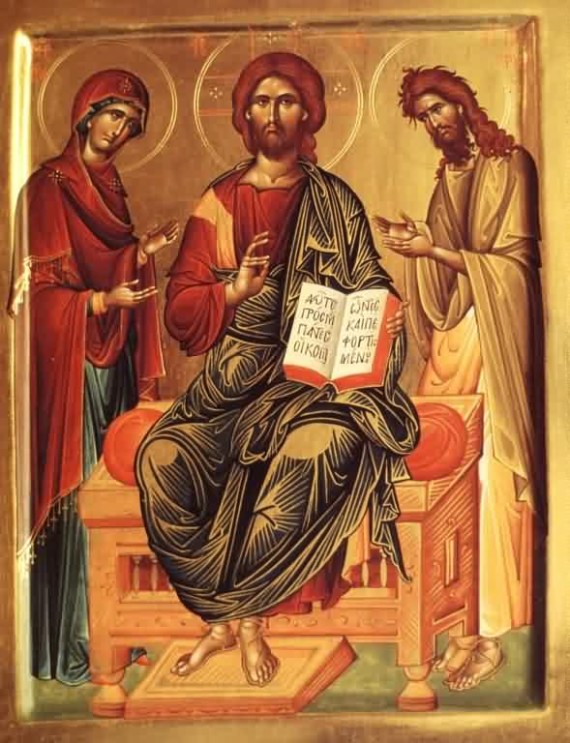
Do you remember when Sts. James and John wanted to be the ones seated at Christ's right and left hand in His kingdom? And our Lord said that it was not for Him to choose, but those places have been prepared already for others. I don't know if there is an official teaching on this one, but when I think of that passage this icon comes to mind:

Icon courtesy of OrthodoxIcons.com. An appropriate festal icon is located at the Antiochian site.
Do you remember when Sts. James and John wanted to be the ones seated at Christ's right and left hand in His kingdom? And our Lord said that it was not for Him to choose, but those places have been prepared already for others. I don't know if there is an official teaching on this one, but when I think of that passage this icon comes to mind:
Icon courtesy of OrthodoxIcons.com. An appropriate festal icon is located at the Antiochian site.
Thursday, August 6, 2009
Holy Transfiguration
It's been a long time since I've been able to work up the nerve to post. The Lord Jesus, through His mercy and the prayers of His Mother and His Saints, has been blessing me with some new progress in my recovery. Yet I am still reminded by my doctor, "Rome was not built in a day." True. But also true is that Christ my Lord truly has been merciful to me.
This evening my family and I made the journey to Ft. Wayne for the Vesperal Liturgy of the Holy Transfiguration and the Blessing of Grapes. Normally we go on Saturdays for catechesis and Sundays for Liturgy. I like the Vesperal Liturgy. It's an elision of Vespers and the Eucharistic Liturgy. Plus, I'm getting used to singing the music.
While looking in the bookstore our lead chanter and choir director asked me if I could read a prophesy. Read, yes. Give, no. He showed me what to do. I sometimes get asked to do something when people are scarce. A book I was reading recently explained that males tend to learn better by doing and through apprentice-like relationships. I find this is true for me, so I appreciate opportunities to help out (and I like to help).
Anyway, after the Liturgy our priest blessed the grapes provided by sprinkling them with holy water. These rites and services are always beautiful and speak to the heart of the Faith and Life in Christ's kingdom.
Our priest, Fr. Anthony, had a short sermon on the Transfiguration. It was good. He's very well versed in Orthodox theology (it is evident, plus Bishop MARK gives him high marks), and he gets to the point very well. I had read on the back of our bulletin already how what was revealed outwardly to the disciples was the inner reality of our Lord that had normally been hidden. What was also revealed, though, was Moses and Elijah. But it's not like they showed up and then went away. Christ's transfiguration revealed them, because they are in Him and He in them. It's true that Enoch and angels were not revealed, but that's because the focus here is on Christ's coming exodus to the cross that fulfills the exodus of the OT Jews. But Moses and Elijah are there because they are always there in Christ, as are angels and all now who have been liberated from Hades/Sheol and are with Him. This isn't a recap of the sermon, but just the effect the sermon had on me and my wife. I have trouble remembering good sermons, probably because I'm too busy enjoying them to retain them :-)
We are in the fellowship hall of our new building now. Everyone in the congregation is so happy; it's the fulfillment of a life-long dream for them to construct their own building. Here's a couple pictures.


This evening my family and I made the journey to Ft. Wayne for the Vesperal Liturgy of the Holy Transfiguration and the Blessing of Grapes. Normally we go on Saturdays for catechesis and Sundays for Liturgy. I like the Vesperal Liturgy. It's an elision of Vespers and the Eucharistic Liturgy. Plus, I'm getting used to singing the music.
While looking in the bookstore our lead chanter and choir director asked me if I could read a prophesy. Read, yes. Give, no. He showed me what to do. I sometimes get asked to do something when people are scarce. A book I was reading recently explained that males tend to learn better by doing and through apprentice-like relationships. I find this is true for me, so I appreciate opportunities to help out (and I like to help).
Anyway, after the Liturgy our priest blessed the grapes provided by sprinkling them with holy water. These rites and services are always beautiful and speak to the heart of the Faith and Life in Christ's kingdom.
Our priest, Fr. Anthony, had a short sermon on the Transfiguration. It was good. He's very well versed in Orthodox theology (it is evident, plus Bishop MARK gives him high marks), and he gets to the point very well. I had read on the back of our bulletin already how what was revealed outwardly to the disciples was the inner reality of our Lord that had normally been hidden. What was also revealed, though, was Moses and Elijah. But it's not like they showed up and then went away. Christ's transfiguration revealed them, because they are in Him and He in them. It's true that Enoch and angels were not revealed, but that's because the focus here is on Christ's coming exodus to the cross that fulfills the exodus of the OT Jews. But Moses and Elijah are there because they are always there in Christ, as are angels and all now who have been liberated from Hades/Sheol and are with Him. This isn't a recap of the sermon, but just the effect the sermon had on me and my wife. I have trouble remembering good sermons, probably because I'm too busy enjoying them to retain them :-)
We are in the fellowship hall of our new building now. Everyone in the congregation is so happy; it's the fulfillment of a life-long dream for them to construct their own building. Here's a couple pictures.

The church proper doesn't yet have a door or all the windows.

The construction workers aren't too thrilled about the drywall work needed to finish the dome.

The church for now is the fellowship hall. Neat modern chandeliers. The on/off switches aren't hooked up yet, so they have to be switched on from the fuse box.

It was Fr. Anthony's idea to put the crucifix at the center, since "it is the symbol of our salvation." I enjoy being able to see and hear everything going on behind our transparent iconostasis.
Subscribe to:
Posts (Atom)